
 Back to services
Schematic design

The schematic design stage is when the architectural concept acquires specific parameters and is tested for practical feasibility. It formalises the volumetric and spatial structure, planning solutions, and principal structural decisions, and establishes the key dimensions and height indicators of the building.
The schematic design package includes floor plans, sections, façade solutions with specified materials, a roof plan, and a master plan with a basic development of landscaping and engineering logic. This stage creates the foundation for further design development, budget formation, scheduling, and the completion of permitting procedures.
What the schematic design includes
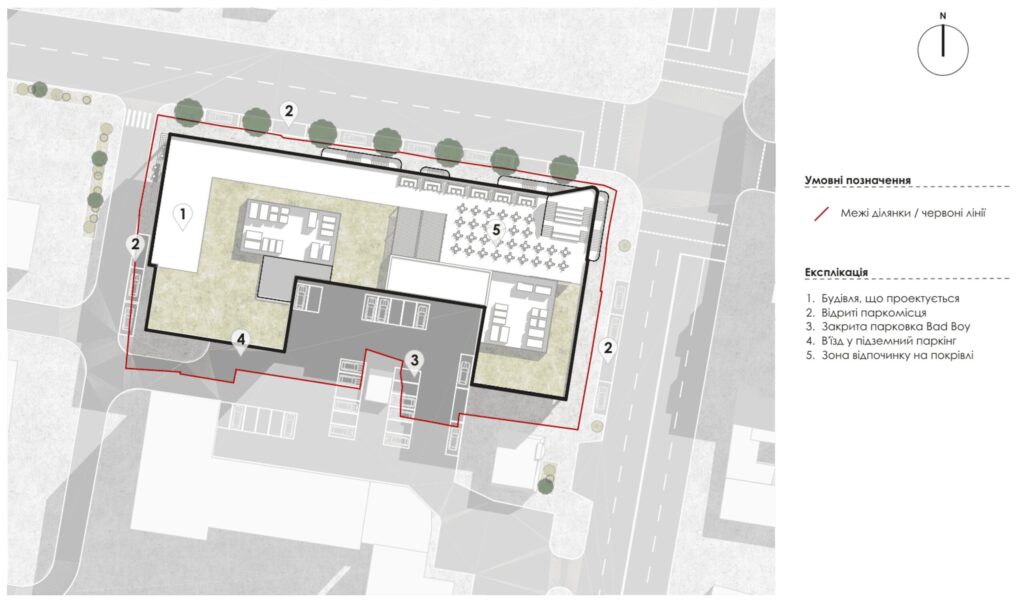
The scope is not arbitrary. It is set out in Annex G of the Ukrainian building code DBN A.2.2-3:2014, “Composition and Content of Design Documentation for Construction”, in its current wording with Amendment No. 2. The annex is informative, so the list is refined by the design brief — but it is the reference point every practice works from.
General explanatory note:
- input data for design and a brief description of the building;
- results of engineering surveys;
- construction phases and commissioning complexes;
- requirements for urban planning solutions;
- accessibility for people with reduced mobility under DBN V.2.2-40;
- key technical and economic indicators;
- cost estimate documentation under Ukraine's cost estimating standards;
- calculation of the consequence class under DSTU 8855, the design service life and the principal structural and technological solutions;
- calculation of population density under DBN B.2.2-12;
- fire safety;
- principal provisions for construction organisation.
Principal drawings:
- a location plan at 1:2 000, 1:5 000 or 1:10 000;
- a master plan layout at 1:500 or 1:1 000;
- a diagram of vehicle and pedestrian connections, where needed;
- floor plans, elevations and sections;
- an information model of the site and an information model of the building, where needed.
At the client's request, the package also includes schematic layouts of building services, technological arrangements and structural solutions. Drawings in electronic form can be produced from the building's 3D information model.
Where the schematic design sits among the design stages
The regulations define six stages: feasibility study (TEO), feasibility calculation (TER), schematic design (EP), design stage (P), detailed design (RP) and construction documentation (R). Not every building needs all of them — the set is determined by the building's purpose and its consequence class. For non-industrial buildings in class CC1, two-stage design means EP and RP; for CC2 and CC3 it means P and R; three-stage design runs EP, P and R.
The schematic design opens the chain. Under the regulations it is developed from the input data to establish, in principle, the requirements for urban planning, architectural, artistic, environmental and functional solutions — and to confirm that the building can be created at all under the given conditions and within the given estimated cost. Once approved by the client, it becomes the preceding stage for the design stage (P) or the detailed design (RP).
How the schematic design differs from the design stage (P) and detailed design (RP)
These are different stages with different jobs, not two levels of detail of the same document. The schematic design answers “is this feasible, and what will the building be”: it fixes dimensions, height indicators, the planning structure and the character of the façades.
The design stage (P) answers “which solutions are adopted, and what will construction cost”: it defines the building's urban planning, architectural, technical, technological and engineering solutions and its estimated cost, in enough depth to justify them. Construction documentation (R) is then developed from it, and that is what the building is built from. Detailed design (RP) combines both parts, an approval part and construction documentation; the regulations recommend it for technically simple buildings and for buildings that reuse existing design solutions.
The earlier a decision changes, the cheaper it is: at the schematic stage a change mostly affects the architectural drawings, while later it means revising the structural and building services sections and the cost estimate.
Why the schematic design matters
It is the first document you can actually make decisions with, and show to other parties:
- estimate cost and timeline before the expensive stages begin;
- verify that the intended programme fits the site within the applicable norms and restrictions;
- agree solutions with the client, investor or partners on drawings rather than on verbal descriptions;
- obtain material for approvals with the urban planning and architecture authorities;
- hand the next stage a verified basis instead of a raw intention.
How we develop a schematic design
The sequence is built so that every decision rests on verified data rather than on assumptions.
- Input data. We collect urban planning conditions and restrictions, technical specifications, the design brief and the engineering survey results.
- Testing the intent. We overlay the concept onto the real constraints of the site: setbacks, height limits, insolation, fire access routes, transport links.
- Volumetric and spatial structure. We fix the building footprint, the number of storeys, the planning structure and the functional zoning.
- Façades and structure. We develop façade solutions with materials and set the principal structural decisions. The colour scheme is set later, at the working documentation stage, in the façade finishing passport.
- Indicators and handover. We compile the technical and economic indicators, agree the package with the client and hand it on to the next stage.
How much a schematic design costs
The price depends on the amount of work, and that differs every time — naming a single figure without input data is not possible. What drives it:
- floor area and number of storeys, the building's purpose and consequence class;
- complexity of the site: terrain, existing development, urban planning restrictions;
- the number of functions in the building — a mixed-use complex is harder than a single function of the same area;
- how far façades and structure are developed, and whether building services diagrams are needed;
- timeline: a compressed schedule means a larger team working in parallel.
To quote, we need the urban planning conditions and restrictions, the site data and the design brief. On that basis we prepare a proposal with a scope of work and a duration for the stage.
Adjacent stages
The schematic design is preceded by the architectural concept (pre-design proposals), which shapes the idea and the functional model of the building. Once the schematic design is approved, work moves on to the design stage and then to construction documentation. All the stages AIMM covers, from concept to architectural supervision, are listed in services.
Frequently asked questions
It is the stage where an intention turns into actual drawings and is tested for feasibility: what exactly will be built, at what size, how it sits on the site and what the façades are made of. A document you can already cost and negotiate with.
An explanatory part with input data, a description of the building, technical and economic indicators, cost estimate documentation and the consequence class calculation; plus the principal drawings — location plan, master plan layout, floor plans, elevations and sections. The list is given in Annex G of DBN A.2.2-3:2014 and is refined by the design brief.
The schematic design establishes what the building will be and whether the intent is feasible under the given conditions. The detailed design contains the decisions construction work is carried out from, and under the code it is developed for technically simple buildings and for buildings reusing existing design solutions. They are separate stages, not two levels of detail of one document.
It is a recognised design stage under DBN A.2.2-3:2014 and is handed to the client on paper and in electronic form. It is not, however, a permit in itself: construction rights are obtained through the subsequent stages and the statutory procedures that apply to the building’s consequence class.
It depends on the area and purpose of the building, the number of functions in it, the complexity of the site and how complete the input data is. Most often the delay comes not from drawing but from waiting for urban planning conditions and technical specifications. The duration is fixed at the start together with the brief.
No. It does not contain the decisions construction work is carried out from — the following stages are needed for that: the design stage or detailed design, and construction documentation. What it does give you is a verified basis, indicators for the budget and material for approvals.
request