

What vertical greening is
Ukraine’s Rules for the Maintenance of Green Spaces in Settlements (a 2006 ministerial order) define vertical greening as “elements of greening on building façades, park structures, special openwork structures, vertical walls and other objects using woody lianas and other climbing plants”. In other words, in the classic sense it means climbers: Boston ivy, common ivy, grapevines, hops.
Ukraine’s state building codes (DBN) take a broader view. DBN B.2.2-12:2019 Planning and Development of Territories lists vertical greening of façades, balconies and noise barriers among the means of greening built-up areas, and names vertical gardens and parks (carpet and modular), green screens and walls, and mobile systems as innovative means (cl. 8.2.6). DBN B.2.2-5:2011 Landscaping of Territories distinguishes three planting techniques — stationary (in the ground), mobile (in movable containers) and compact, which includes vertical greening. Mobile and compact techniques are used where there is little free soil and the ground below is full of utilities (cl. 9.9.1 and 9.9.3).
Indoors, the term also covers green walls of modules with live plants and automatic irrigation, and panels of stabilised moss or artificial plants. Stabilised moss is preserved and no longer grows, so it needs neither water nor light. A moss panel is interior décor, not façade greening.
Types of vertical greening systems
There are four main systems: a direct green façade, an indirect green façade on supports, planters on balconies and terraces, and a living wall. They differ in where the roots grow and what supports the foliage. That determines the load on the façade, the upkeep and how forgiving the system is of mistakes.
| System | How it works | Upkeep |
|---|---|---|
| Direct green façade | Self-clinging climbers such as Boston ivy or, in sheltered spots, common ivy grow from the soil at the foot of the wall and cling to it unaided | Pruning to keep shoots out of windows, gutters and the roof |
| Indirect green façade (on supports) | Climbers grow up cables, meshes or trellises fixed at a distance from the wall | Pruning, inspection of fixings and supports |
| Planters on balconies and terraces | Trees, shrubs and trailing plants grow in soil-filled containers storey by storey | Automatic irrigation, seasonal gardening work, access to every planter |
| Living wall | Plants grow in modules, pockets or felt layers with growing medium on a frame; water and nutrients are supplied automatically | Constant monitoring of irrigation and nutrients, plant replacement, a maintenance contract |
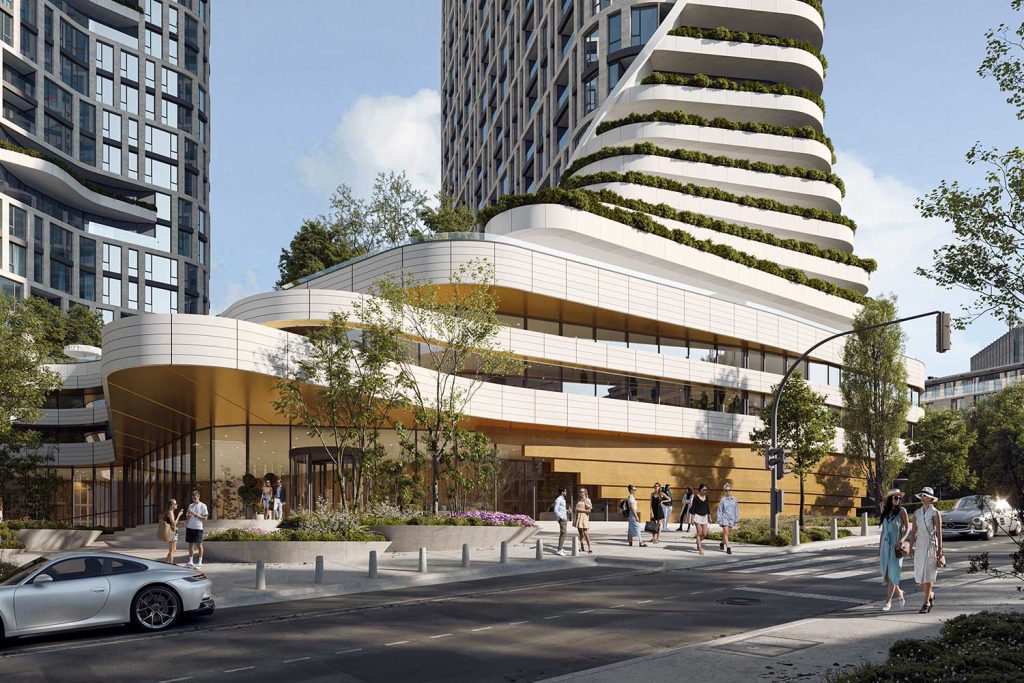
Together, direct and indirect façades are known as green façades; in research, green façades and living walls are grouped together as green walls, and in everyday use the term covers any vertical greening. The planter option is used in the concept for the Prime Residence housing complex in Kyiv: shrubs run in continuous bands along the tower’s terraces.
The more technology a system contains — modules, growing medium, pumps — the more it depends on constant care. A direct façade is the simplest: essentially, a plant and a wall.
What a green façade does in Ukraine’s climate
Marketing claims that green walls “cool the city”. Measurements in a temperate climate tell a more modest story. In 2025 Czech researchers published data from five green walls in Prague, Olomouc and Opava. On hot days, 50 cm from façades covered with Virginia creeper and Boston ivy, the air was on average 0.7–0.8 °C cooler than next to conventional walls, and in one case the difference reached 2 °C in the late afternoon. Next to living walls with black pots on a frame, the result was mixed: in one case there was almost no difference, in another the air was 1.2 °C cooler than next to glass but warmer than next to a metal grid. For Ukraine this is the closest available benchmark: the Czech Republic also lies in the temperate zone.
For the building something else matters more: plants shade the wall itself. According to other studies cited by the Czech authors, in Ljubljana, walls without greening heated up by as much as 29 °C more than green façades. In London greening lowered the surface temperature by 12 °C. A cooler wall means less heat indoors, especially on west-facing façades that suffer most from the evening sun (on orientation, see our article on insolation).
In winter, deciduous climbers drop their leaves and the wall is open to the sun. Climbers on cables in front of glazing behave the same way: they shade the glass in summer and let the sun through in winter. Evergreen ivy works like a blanket: on limestone walls near Oxford, the stone under it froze 26% less often, and freezing periods were 34% shorter and 32% less severe. But the measurements were taken in the mild climate of southern England: ivy buffered frosts down to −3.5 °C, and the authors cannot yet say how it would behave in harder frosts. Ivy also copes poorly with long cold spells of −2 °C and below, although it survives short frosts down to −25 °C, so Boston ivy is the more reliable choice for most of Ukraine.
Do climbers damage walls?
Not if the masonry is sound: ivy stems cannot bore into an intact wall, and Oxford researchers rate the risk to it as negligible if the plants are kept away from gutters and roofs. Damage starts where there are already cracks, holes or crumbling mortar: the climber grows into the defect and widens it. And tearing old, well-established ivy off a wall can do more harm than leaving it.
The City of Luxembourg’s façade greening guide boils this down to two rules: self-clinging climbers only on sound masonry without cracks, and never on an insulated façade. Where damage cannot be ruled out, and on insulation and cladding, climbers that need supports are used; on an insulated façade the supports are fixed with special thermally broken anchors.
In short: on sound, uninsulated brick or concrete — a direct green façade; on an insulated, clad or ventilated façade — climbers on supports; in front of glazing — cables with climbers that shade the façade. A living wall is worth considering only with a maintenance contract, a water supply and a sound, uninsulated wall that can carry the weight of the modules. If no one will maintain it, conventional greening of the courtyard, terraces and roofs is the honest choice.
What grows in Kyiv
Reliability depends on where the roots grow. A UK report on the fire performance of green roofs and walls notes that climbers rooted in the ground can survive even without an irrigation system, and the Luxembourg guide advises planting façade climbers directly in the ground, not in containers. In planters and modules high up, roots lack the protection of deep soil around them and freeze more than in the ground, and winter thaws and spring frosts are common across most of Ukraine. That is why in our climate climbers rooted in the ground — directly on the wall or on supports — are the most reliable.
For greening façades in the city, Kyiv’s Department of Ecology and Natural Resources recommends Boston ivy. In 2022 the city launched the City of Living Walls initiative, and the department’s own office building was the first to get a green façade. Despite the name, the initiative is specifically about climbers on façades; it includes no modular living walls. Boston ivy is undemanding and clings to the wall on its own with adhesive tendrils; according to the city’s ecologists, its shoots grow 1–3 m a year. At that rate a climber will take more than a year to cover a tall façade, so on high-rise buildings greenery is often brought onto terraces and balconies instead, as in the Prime Residence concept — but then root protection and care have to be built into the design.
Near windows and gutters, plants that need supports work better: grapevine, actinidia, hops, clematis, honeysuckle. The choice depends on orientation: plants on south- and west-facing walls usually suffer from heat and drought, those on north-facing walls lack light, so the plant palette is chosen façade by façade.
Ukraine’s maintenance rules also describe the planting itself. Climber saplings should have shoots at least 1 m long. The planting pit, 50 cm deep and 50–60 cm wide, is dug 30–40 cm from the support and filled with fertile soil. After that come feeding, generous watering and mandatory regular pruning. The Luxembourg guide recommends more room: at least 0.5 m² of open soil per plant, a planting pit of 1 m³ or more and 60–80 cm from the façade. For a private house, the easiest place to start is a fence or a pergola: climbers grow on them too, with no fixings to the façade, no automatic irrigation and no maintenance contract.
Why upkeep matters more than installation
A systematic review of 15 studies on the economics of green walls, presented at the World Construction Symposium in 2022, concludes that for every system the largest cost over its service life is annual maintenance, not installation.
The gap between a green façade and a living wall has been measured too: in a 2018 Portuguese study, maintaining a living wall cost 16 times as much as a green façade, and in another study from 2020, 12 times as much. That is why a system should be chosen not for how it looks on a rendering but for who will look after it, and for how many years.
In these studies, savings on heating and cooling, a longer-lasting façade and higher property value mostly offset the costs, upkeep included. But only 4 of the 15 studies put a monetary value on the benefits.
What well-known projects show
The best-known example is Bosco Verticale in Milan: two residential towers 110 and 76 m high in the Porta Nuova district, designed by Boeri Studio (Stefano Boeri, Gianandrea Barreca, Giovanni La Varra), 2007–2014. Their balconies hold 800 trees, 4,500 shrubs and 20,000 other plants — the equivalent of about five hectares of parkland concentrated on roughly 1,000 m².
Care is centralised: irrigation is managed remotely for the whole building, twice a year the trees are pruned by flying gardeners who abseil down the façade, and twice more a year maintenance is carried out from inside the apartments.
The opposite case is Qiyi City Forest Garden in Chengdu. Its eight towers with balcony gardens sold out: all 826 apartments had been bought by April 2020. But only about ten families moved in: plants on the abandoned balconies grew wild, and a mosquito infestation kept the other owners from moving in. The balcony gardens relied on residents who never came.
The living wall at CaixaForum in Madrid (the Jardín Vertical, or “vertical garden”), created by French botanist Patrick Blanc, is an example of a system that depends entirely on engineering. On a wall 24 m high with an area of 460 m², more than 15,000 plants of 250 species grow without soil. They are anchored to five pipe structures, water is delivered through perforated pipes at three levels, and about half of the water is reused. Climbers cannot offer such variety and height without soil, but this wall lives only as long as the irrigation works and someone keeps an eye on it.
The lesson of all three is the same: greenery on a façade survives as long as its care is built into the operation of the building rather than left to the residents.
What the codes say
Codes measure greening by area. On residential and public development land, greening must cover at least 25% (DBN B.2.2-12:2019 with Amendment No. 1, Table 8.2), and a neighbourhood needs at least 6 m² of green space per resident (or 12–15 m² per apartment, cl. 6.1.5). For public green spaces in cities of more than 250,000 people, the standard is higher — 10–15 m² per person, depending on the natural zone (Table 8.1).
Although cl. 8.2.6 calls green walls an innovative means of increasing green space, the code does not say how to count them towards these figures. DBN B.2.2-5:2011, however, allows vertical greening and gardens on building roofs to be used for compensatory planting (replacement planting for green space lost to construction) in dense development (cl. 9.9.15); the general rule of the same clause is that the number of plants and the area they occupy must not be reduced. A green wall counted as compensation will need years of care, just like the trees in a courtyard. How compensatory planting works and why it is built into the schedule and budget from the start is explained on our landscape architecture page. For mobile and vertical greening the code names the devices — trellises, espaliers, pergolas, flower boxes and planters (cl. 9.6.3) — and sports grounds are enclosed with vertical greening (cl. 6.9.3).
What to plan for in the design
Vertical greening should be designed together with the façade, at the architectural concept stage, not after the building is handed over. What needs to be settled before greenery is drawn on a rendering:
| Question | What to plan for |
|---|---|
| Upkeep | Who will maintain it and how it will be funded: a maintenance contract and a budget for years ahead. After handover, responsibility is assigned to the management company or owners’ association, not to each resident. Without irrigation and care, the plants on a living wall will not survive |
| Choice of system | Orientation, height, insulation, windows and gutters. On an insulated façade, use plants on supports |
| Weight and fixings | A saturated living-wall panel measuring 1000 × 600 mm weighs 50–60 kg, so a structural engineer must check the wall at the design stage |
| Irrigation | Water source, controls and sensors, how the system is drained for winter |
| Access | How to reach every plant: from balconies, from a cherry picker or by rope access |
| Fire safety | Combustible frame and module materials can spread flame, and the cavity between the panels and the wall needs cavity barriers |
| Plants | Species suited to the climate and orientation, frost protection for roots in containers |
The same UK report cites the general view that as long as a green wall is kept moist, it is very resistant to ignition, while one that dries out — in a drought without irrigation, for example — may be more of a fire risk. The report’s own tests showed that it is mainly the frame and module materials that burn. And care is needed all the time: living walls are never “maintenance-free”, and maintenance contracts are usually signed for a year, sometimes for up to 10 years.
When vertical greening is worth it
Climbers rooted in the ground — directly on the wall or on supports — are the most reliable and the easiest to maintain in our climate. Living walls and storey-by-storey planters are specialist tools with high operating demands. But both climbers and complex systems are justified under three conditions: there is an owner ready to fund maintenance for years; the system suits the climate and the orientation of the façade; and it is expected to do what it actually does — shade the wall and protect it from overheating. A green wall cannot noticeably cool a street.
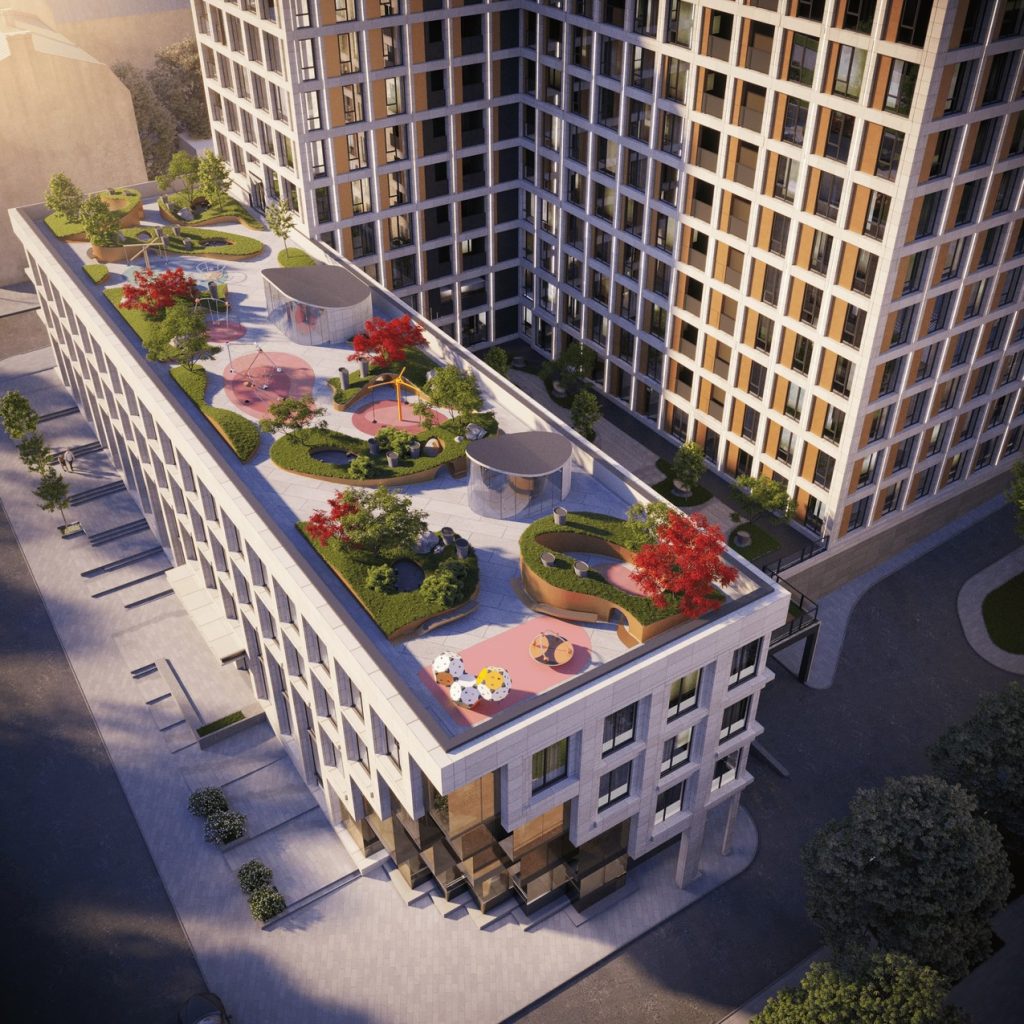
At AIMM we treat vertical greening as an engineering system with an operating budget. If a client is not ready to budget for upkeep decades ahead, we talk about conventional greening straight away: trees in the courtyard, gardens on roofs and terraces that a gardener can simply walk to. Roof and terrace gardens are containers of soil too, but they are tended from the terrace rather than by abseiling or through apartments. In the CENTOWER project in Dnipro the residential sections step down in a cascade, and the greenery is concentrated on the terraces and in a roof garden. Such greening looks less spectacular on a rendering, but it will outlast the first winter without irrigation.
Sources
- Rules for the Maintenance of Green Spaces in Settlements of Ukraine — Order of the Ministry of Construction No. 105 of 10 April 2006 (in Ukrainian)
- DBN B.2.2-12:2019 Planning and Development of Territories — official entry in Ukraine’s Unified State Electronic System for Construction (in Ukrainian)
- Amendment No. 1 to DBN B.2.2-12:2019 — Ministry for Development of Communities and Territories, in force from 1 January 2026 (in Ukrainian)
- DBN B.2.2-5:2011 Landscaping of Territories — official entry, with Amendments No. 1–3 (in Ukrainian)
- Madushika U. G. D., Ramachandra T., Geekiyanage D. Economic performance of green walls: a systematic review — 10th World Construction Symposium, 2022
- Lehnert M. et al. Assessing green walls’ effects on outdoor human thermal exposure in temperate climate cities — Scientific Reports, 2025
- Coombes M. A., Viles H. A., Zhang H. Thermal blanketing by ivy (Hedera helix L.) can protect building stone from damaging frosts — Scientific Reports, 2018
- Fassadenbegrünung — façade greening guide, City of Luxembourg (in German)
- Fire Performance of Green Roofs and Walls — UK Department for Communities and Local Government, 2013
- Vertical Forest — Stefano Boeri Architetti, Bosco Verticale project page
- Welcome to the jungle: plants overrun Chinese apartment blocks — AFP, 15 September 2020
- Jardín Vertical CaixaForum — official tourism website of Madrid (in Spanish)
- City of Living Walls: Kyiv introduces a vertical greening strategy — PRAGMATIKA.MEDIA, 2022 (in Ukrainian)
- Nataliia Korotka. Green wall as an investment: figures versus marketing — column for PRAGMATIKA.MEDIA, 2026 (in Ukrainian)